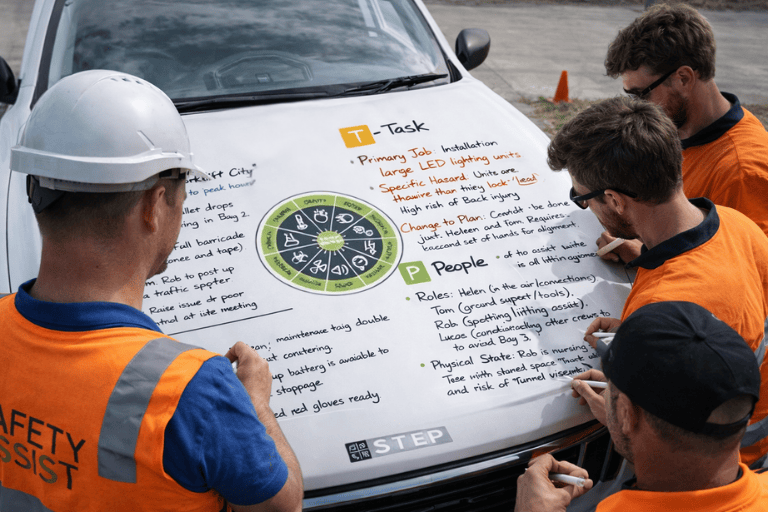
STEP™ helps organisations move beyond tick-box pre-starts. It gives workers a simple, practical way to tell the story of the work before it begins; the site, the task, the equipment and the people, so teams can build a shared understanding of what needs to go right, what could make work difficult, and what controls need to stay reliable as conditions change.
STEP™: Pre and Post Work Discussions For Work To Go Well
STEP™ transforms everyday work conversations into operational intelligence.
The world of work has changed. Complexity has increased. Traditional safety tools are losing effectiveness. STEP™ is built on modern HOP principles. It recognizes that workers are not the problem to control; they are the solution to understand.
STEP™ strengthens controls, improves quality, reduces operational drift, and creates visible learning from everyday work. It improves performance, not just safety metrics. And it does it in a way that engages workers, empowers frontline leaders, and gives organizations and contract principals insights to learn from.
STEP™ is not another safety program. It is a performance improvement framework built on HOP principles. It bridges the gap between:
- Work as Planned and Work as Done
- Controls and care
- Compliance and performance
- Learning and results
In contractor management relationships, STEP™ serves as a performance framework for communication, coordination, and cooperation among multiple parties.
How STEP™ Helps Workers
How STEP™ Helps Frontline Leaders
How STEP™ Helps Organizations
How STEP™ Helps Workers
STEP™ helps workers turn pre-starts into real conversations about real work.
Built around Site, Task, Equipment and People, STEP™ gives workers a simple way to explain what is happening, what has changed, what could make the job difficult, and what support is needed for the work to go well.
Rather than relying on a supervisor-led checklist, STEP™ invites workers to tell the story of the job before it starts. This supports better participation, stronger worker voice, clearer role understanding, and a shared picture of the work.
Evidence from toolbox talk research shows that story-based discussions with questions improve worker knowledge and training impact compared with standard fact-based safety talks. STEP™ applies this principle in a practical way by helping crews move from passive listening to active sensemaking.
For workers, STEP™ means they are not just being told about safety. They are helping shape the plan, test the controls, identify what could go wrong, and decide what needs to happen before the work starts.
How STEP™ Helps Frontline Leaders
STEP™ helps frontline leaders run better pre-start conversations.
Instead of relying on scripted safety talks or checklist confirmation, STEP™ gives supervisors a practical way to lead a structured conversation about the work through Site, Task, Equipment and People.
For frontline leaders, STEP™ supports better planning, clearer roles, stronger worker participation, and earlier identification of the things that could make work difficult. It helps them move from telling the crew about safety to listening, testing the plan, and building a shared picture of how the work will actually happen.
STEP™ also helps frontline leaders manage the real pressures of daily work. It makes it easier to talk about changing site conditions, unclear sequencing, equipment issues, contractor interfaces, staffing, fatigue, time pressure and brittle controls before the job begins.
The result is a more useful pre-start: one where the frontline leader does not just confirm that the crew has heard the plan, but checks whether the plan makes sense for the work as it will actually be done.
How STEP™ Helps Organizations
STEP™ helps organisations learn from everyday work and strengthen assurance.
Traditional pre-start assurance often focuses on whether the meeting was completed and the form was signed. STEP™ shifts the focus to whether the crew developed a useful understanding of the work.
By structuring the conversation around Site, Task, Equipment and People, STEP™ helps organisations capture what workers are seeing, what has changed, what could make the job difficult, what controls are being relied on, and where those controls may be brittle or hard to use.
This creates a richer source of learning than a standard hazard checklist. Over time, STEP™ conversations can reveal repeated patterns across teams, shifts and sites, such as unclear interfaces, poor planning, missing equipment, weak communication, time pressure, difficult controls or conditions that cause workers to adapt.
For assurance, STEP™ provides leaders with better evidence that the work was understood, not just that the pre-start was completed. It helps test whether roles were clear, controls were discussed, reset points were agreed, and worker voice was included. In this way, STEP™ supports both operational learning and leadership assurance.
It helps organisations move from asking, “Was the form filled out?” to asking, “What did we learn about how work is really being done, and what needs to improve?”