
The Five Principles
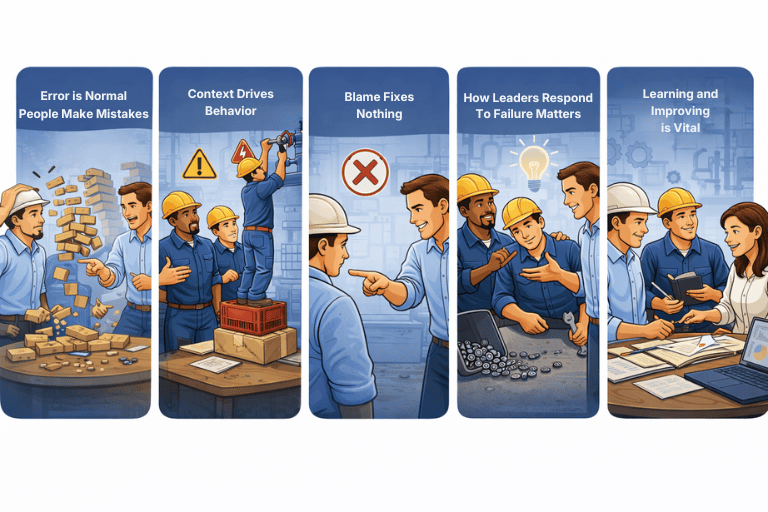
Error Is Normal
Context Drives Behavor
Blame Fixes Nothing
How Leaders Respond to Failure Matters
Learning and Improving is Vital
Error Is Normal

Error Is Normal, People Make Mistakes
The most crucial aspect of this principle of HOP is understanding that errors are so commonplace that they often lose their intrigue. Eventually, you'll reach a point where the actual mistake made by a worker during an investigation and corrective action process will hold little significance.
Once you accept the normalcy of errors, your interest and curiosity will shift toward work being done in an environment that lacks tolerance for inevitable errors and mistakes.
Your thinking will shift from the presence of error or mistakes as the problem to identifying system weaknesses or brittleness that lacks tolerance for failure.
It is normal for us to worry about errors. Over time, you won’t worry much about errors anymore; errors are normal. Applying the other principles will support you to see the working conditions that are not error tolerant and the systems that are so brittle or fragile that when the error occurs, it results in unacceptable consequences for workers, their families, the wider community, and the organization.


Context Drives Behavor

Context Drives Behavior
The assertion that context influences and drives behavior is supported by scientific evidence demonstrating the significant role systems and their design play in shaping behavioral outcomes.
However, it can be challenging to accept, especially when we have been conditioned to believe that worker behavior is a personal choice.The traditional view that workers choose to perform tasks safely or unsafely places the responsibility of safety on the individual, making it less of an organizational issue and more of a personal one.The context or environment in which work is performed has a significant influence on worker behavior.
Good systems can help manage uncertain operational outcomes. Plans, processes, and procedures are all part of the operational context that you manage in your organization.It's crucial to manage this context intentionally.
Understand what your system does and doesn't do for your workers and consistently monitor your context to identify if you are achieving the desired outcomes.If positive outcomes are not occurring, don't ask "who" is failing; ask "what" is failing.
Start by examining the system to understand worker behavior, rather than focusing on identifying the offending behavior.

Blame Fixes Nothing
Blame Fixes Nothing
Blame is a powerful tool that can quickly identify who is at fault. It can be seductive due to its simplicity and cleanliness. Identifying blame is much easier than fixing processes. Blame assigns responsibility for failure to an individual after the failure has occurred, thereby absolving the larger system, process, or organization of any accountability.
The problem with blame is that it does not lead to any solutions. Blame is emotionally satisfying, but it does not fix anything. It may provide a sense of justice by punishing the guilty party but it does not lead to learning or improvement. Blaming, although sometimes emotionally satisfying, does not lead to any tangible improvements.
Blame can also lead to counterproductive reactions. These reactions can include punishment, retraining, and awareness challenges, which can give the organization the illusion of action when, in reality, nothing has been fixed.
Blame can also lead to a culture of fear and avoidance within an organization. When blame is the default response to failure, individuals may become afraid to take risks or innovate for fear of being blamed if things go wrong. This can stifle creativity and hinder progress. Instead of blaming, organizations should focus on learning from failures and mistakes.
This involves understanding what led to the failure and how it can be prevented in the future. It involves creating a culture where mistakes are seen as opportunities for improving through listening, understanding and learning rather than as reasons for punishment.

How Leaders Respond to Failure Matters

How You Respond to Failure Matters
The way you react to failure is of significant importance. Your response can either lead to learning and growth, or it can lead to blame and stagnation. It's crucial to remember that every action you take is being observed by your team. They gauge how to react to both success and failure based on your reactions.
When something goes wrong, you have two choices:you can either blame and punish or learn and improve. But you can't do both. Many leaders struggle with this concept, believing that they can administer justice while also learning from the situation. But the reality is that punishment often leads to fear and mistrust, which can hinder open communication and learning.
When a failure occurs, it's an opportunity to examine the systems and processes in place. Instead of asking "who failed?", shift the focus to "what failed?". This approach allows you to identify any weaknesses in your systems and make necessary improvements.
Remember, improvement is not accidental. It's a result of deliberate actions and decisions made by the leadership. Encourage your team to speak openly about failures and use these instances as learning opportunities. This will not only lead to organizational improvement but also foster a culture of trust and open communication.

Learning and Improving is Vital

Learning and Improving is Vital
This principle of HOP emphasizes the importance of learning and improvement in creating a safe and reliable work environment, “BetterWork”. This principle is not just about learning from our mistakes but also about proactively seeking knowledge and understanding from normal everyday work to prevent future errors and improve performance.
Learning is a strategic and deliberate choice that organizations make towards improvement. It is a strategy that involves understanding how work is done, recognizing the expertise of the workers, and acknowledging that workers complete the process design. Learning requires active engagement, openness to feedback, and a commitment to making changes based on the information received.
It involves asking the right questions or seeking stories about normal work, being open to receiving feedback and co-constructing those changes and improvements with those who do the work and then sharing those learnings with others. Learning also involves understanding the reasons why mistakes occur and applying the lessons learned from past events to prevent future incidents. This approach requires a combination of proactive and reactive strategies.
While learning from past mistakes is important, anticipating potential errors and taking steps to prevent them is a more cost-effective approach to improving human performance.